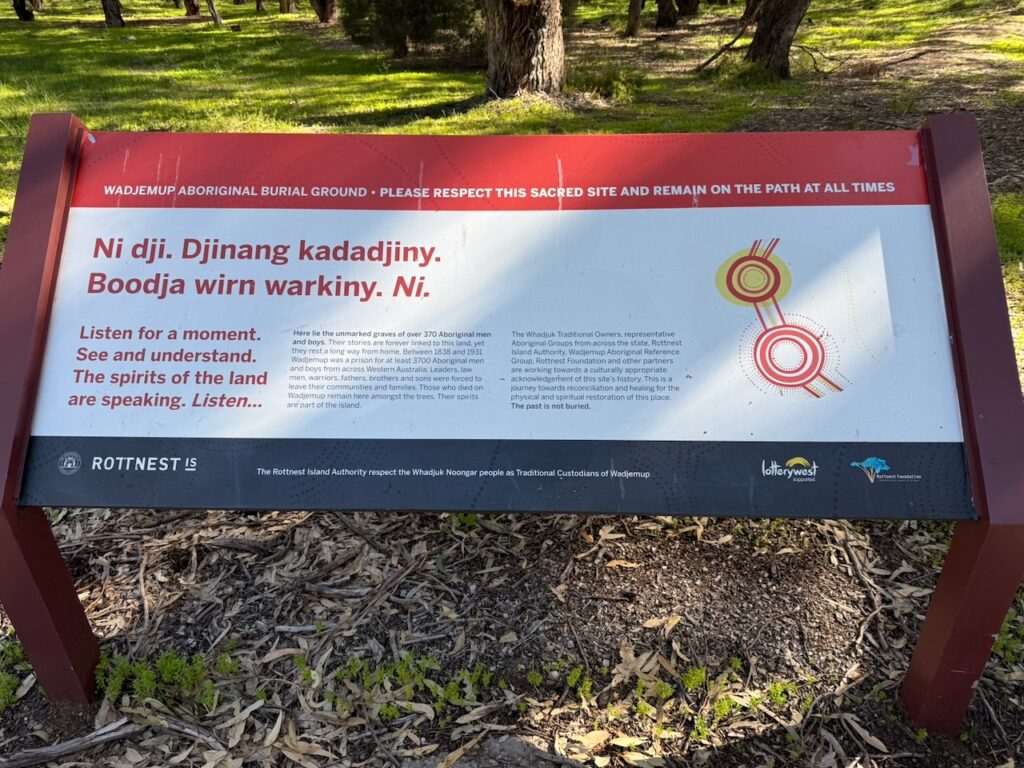
Red white and green sign showing Indigenous art and information about the Indigenous burial ground at the Settlement. It reads:
“WADJEMUP ABORIGINAL BURIAL GROUND • PLEASE RESPECT THIS SACRED SITE AND REMAIN ON THE PATH AT ALL TIMES
Ni dji. Djinang kadadjiny.
Boodja wirn warkiny. Ni.
Listen for a moment.
See and understand.
The spirits of the land are speaking. Listen…
Here lie the unmarked graves of over 370 Aboriginal men and boys. Their stories are forever linked to this land, yet they rest a long way from home. Between 1838 and 1931 Wadjemup was a prison for at least 3700 Aboriginal men and boys from across Western Australia. Leaders, law men, warriors, fathers, brothers and sons were forced to leave their communities and families. Those who died on Wadjemup remain here amongst the trees. Their spirits are part of the island.
The Whadjuk Traditional Owners, representative
Aboriginal Groups from across the state, Rottnest Island Authority, Wadjemup Aboriginal Reference Group, Rottest Foundation and other partners are working towards a culturally appropriate .. acknowledgement of this site’s history. This is a journey towards reconciliation and healing for the physical and spiritual restoration of this place.
The past is not buried.
ROTTNEST IS
The Rottnest Island Authority respect the Whadjuk Noongar people as Traditional Custodians of Wadjemup”
Red white and green sign showing Indigenous art and information about the Indigenous burial ground at the Settlement. It reads:
“WADJEMUP ABORIGINAL BURIAL GROUND • PLEASE RESPECT THIS SACRED SITE AND REMAIN ON THE PATH AT ALL TIMES
Ni dji. Djinang kadadjiny.
Boodja wirn warkiny. Ni.
Listen for a moment.
See and understand.
The spirits of the land are speaking. Listen…
Here lie the unmarked graves of over 370 Aboriginal men and boys. Their stories are forever linked to this land, yet they rest a long way from home. Between 1838 and 1931 Wadjemup was a prison for at least 3700 Aboriginal men and boys from across Western Australia. Leaders, law men, warriors, fathers, brothers and sons were forced to leave their communities and families. Those who died on Wadjemup remain here amongst the trees. Their spirits are part of the island.
The Whadjuk Traditional Owners, representative
Aboriginal Groups from across the state, Rottnest Island Authority, Wadjemup Aboriginal Reference Group, Rottest Foundation and other partners are working towards a culturally appropriate .. acknowledgement of this site’s history. This is a journey towards reconciliation and healing for the physical and spiritual restoration of this place.
The past is not buried.
ROTTNEST IS
The Rottnest Island Authority respect the Whadjuk Noongar people as Traditional Custodians of Wadjemup”